
Ever stumbled upon a Japanese surname that sent chills down your spine? You’re not alone. Japanese last names with dark meanings carry centuries of folklore, myth, and history wrapped in elegant kanji characters. These ominous surnames tell stories of demons, shadows, and forgotten legends.
Let’s explore the fascinating world of eerie Japanese family names.
Why Some Japanese Surnames Feel Dark
Not all darkness is evil. Japanese culture embraces shadows differently than Western traditions. Oni (鬼), for instance, aren’t purely villains. They’re complex beings sometimes guardians, sometimes tests of courage.
The kanji themselves hold power. 黒 (kuro) means “black.” 闇 (yami) translates to “darkness.” When combined with geographical terms like 沢 (sawa, meaning “marsh”) or 塚 (tsuka, meaning “mound”), you get atmospheric surnames dripping with mystery.
Historical context matters too. During the Meiji Restoration in 1868, commoners needed surnames fast. Many chose names reflecting their surroundings. A family near a dark forest? Chimori (血森, “Blood Forest”). Living by a black mountain? Kurayama (黒山). These weren’t horror-inspired Japanese names just descriptions that aged into eeriness.
Japanese Last Names with Ominous Meanings
Here’s where things get deliciously creepy. Check out these dark Japanese surnames:
| Surname | Kanji | Meaning | Vibe |
|---|---|---|---|
| Onizuka | 鬼塚 | Demon Mound | Ancient burial site energy |
| Kurosawa | 黒沢 | Black Marsh | Misty, mysterious wetlands |
| Chino | 血野 | Blood Field | Battlefield aftermath vibes |
| Hyakumeki | 百目鬼 | Hundred-Eyed Demon | Straight-up supernatural |
| Kurotsuka | 黒塚 | Black Tomb | Fukushima’s fearsome ogress legend |
Onizawa (鬼沢, “Demon Swamp”) sounds like where horror stories begin. The legendary Kurozuka myth tells of an ogress in Fukushima Prefecture. These aren’t just names they’re doorways to Japan’s folklore-inspired surnames.
Yamikawa (闇川) means “River of Darkness.” Imagine introducing yourself with that. The kanji 影 (kage) for “shadow” appears in many shadow-themed Japanese family names, creating that perfect balance of beauty and unease.
Cultural & Historical Context Behind Dark Surnames
Japanese naming traditions evolved dramatically. Before 1868, only samurai and nobility carried family names. The Meiji surname adoption changed everything overnight.
Suddenly, millions needed surnames. People looked around. Mountains (山, yama), forests (森, mori), villages (村, mura) these became Japanese place-based surnames. The dark ones? Often tied to superstition or tragic history.
Folklore and mythological inspiration in names runs deep. Oni weren’t monsters to fear exclusively. They represented challenges, transformations, tests. A surname like Onizuka might honor a family’s resilience rather than celebrating demons.
Think of Akira Kurosawa, the legendary film director. His surname (黒沢) literally means “Black Marsh.” Did it influence his cinematic darkness? Perhaps. Symbolic Japanese kanji carry weight beyond literal translation.
Read More: Japanese Names That Start With “K”
Popular Dark Kanji for Surnames
Let’s decode the building blocks of mysterious Japanese last names:
鬼 (oni) – This demon/ogre character appears in Onizuka, Onizawa, Hyakumeki. It’s powerful stuff. Not exactly office-friendly, but compelling.
黒 (kuro) – “Black” shows up everywhere. Kurosawa, Kurotsuka, Kurayama. Darkness without explicit horror.
血 (chi) – “Blood” is rarer. Chino and Chimori use it. These are blood-themed Japanese last names you won’t forget.
闇 (yami) – Pure darkness. Less common than 黒, but more intense. Yamikawa uses this for maximum atmosphere.
影 (kage) – “Shadow” offers subtlety. It whispers rather than shouts.
冥 (mei) – The underworld kanji. Obscure, mysterious, absolutely loaded with names with ancestral meaning.
骸 (mukuro) – Means “remains” or “bones.” Characters like Kuro from Shoulder-a-Coffin Kuro embody this aesthetic perfectly.
Combine these with neutral kanji like 野 (no, “field”), 目 (me, “eye”), or geographical terms, and you’ve got meaningful kanji combinations for days.
Fun Cultural Tidbits
Here’s something wild: Hyakumeki (百目鬼) literally means “Hundred-Eyed Demon.” Can you imagine that on a business card? It’s one of the rarest Japanese last names, but it exists.
Japanese folklore treats oni with nuance. They’re not Satan-level evil. They’re more like… challenging relatives. Sometimes they guard treasures. Sometimes they test heroes’ courage. This complexity makes demon names in Japan fascinating rather than one-dimensional.
The myth of Kurozuka deserves mention. According to legend, an ogress lived in a black mound in Fukushima. Travelers who visited her never left. The surname Kurotsuka connects directly to this tale names inspired by folklore at their finest.
In anime and manga culture, these surnames pop up constantly. Characters with Gothic Japanese names signal their role instantly. Dark surname? Expect complexity, depth, maybe some supernatural abilities.
Tips for Choosing a Dark Japanese Surname
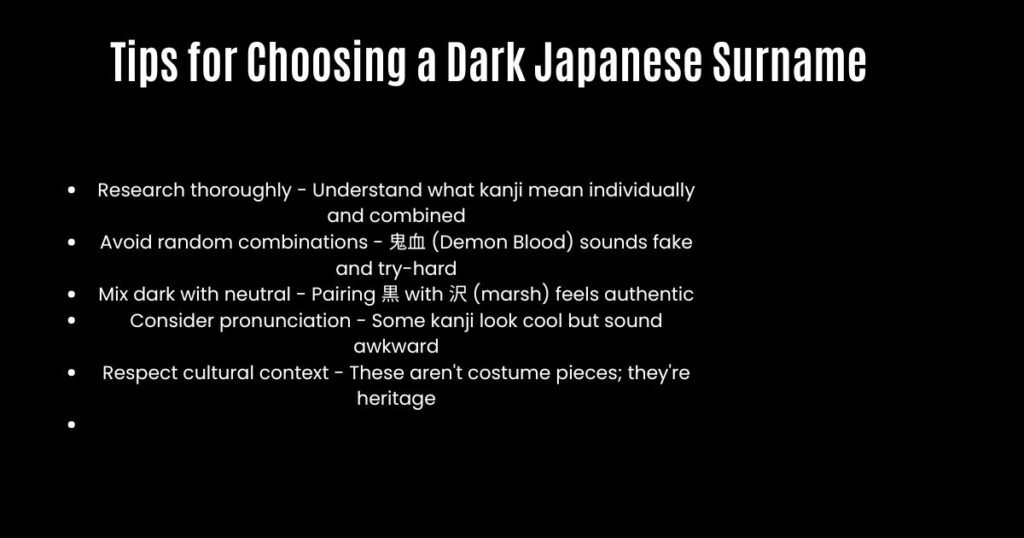
Creating fictional Japanese last names for characters, cosplay, or pen names? Follow these guidelines:
- Research thoroughly – Understand what kanji mean individually and combined
- Avoid random combinations – 鬼血 (Demon Blood) sounds fake and try-hard
- Mix dark with neutral – Pairing 黒 with 沢 (marsh) feels authentic
- Consider pronunciation – Some kanji look cool but sound awkward
- Respect cultural context – These aren’t costume pieces; they’re heritage
Character name ideas should balance atmosphere with believability. Kurosawa works because it’s real and evocative. Making up “Yamioniketsu” (Darkness Demon Blood)? That’s parody territory.
For Japanese pen names or Japanese cosplay names, pick surnames that match your vibe. Writing horror? Onizuka delivers. Dark fantasy character? Try Kurayama. Anti-hero in your manga? Yamikawa fits perfectly.
Dark Surnames & Names in Anime & Manga
Pop culture loves these names. Japanese names in anime leverage dark surnames for instant characterization.
Darker Than Black uses shadow imagery extensively. Watanuki from xxxHolic carries mystical weight in his name alone. These villain surnames in anime and anti-hero names signal complexity before characters speak.
Supernatural character names dominate certain genres. Horror manga creators mine kanji like 冥 and 骸 for that bone-chilling atmosphere. It’s not accidental it’s meaningful kanji combinations doing heavy narrative lifting.
Even mainstream series use this technique. A character named Onizawa immediately suggests danger or hidden power. The audience knows without exposition.
Create Your Own Dark Surname!
Ready to craft creative Japanese last names for storytelling? Here’s your formula:
Step 1: Pick your primary dark kanji
- 鬼 (oni) for demon themes
- 黒 (kuro) for shadow/mystery
- 血 (chi) for intensity
- 闇 (yami) for pure darkness
Step 2: Add a geographical or neutral element
- 沢 (sawa) – marsh
- 山 (yama) – mountain
- 森 (mori) – forest
- 野 (no) – field
Step 3: Check authenticity Does it sound like actual Japanese surname history? Would it survive the Meiji era? If yes, you’ve succeeded.
Example combinations:
- 影森 (Kagemori) – Shadow Forest
- 冥沢 (Meisawa) – Underworld Marsh
- 黒野 (Kurono) – Black Field
Use a Japanese dark name generator for inspiration, but add personal tweaks. The best atmospheric surnames feel both invented and ancient.
Bringing It All Together
Japanese last names with dark meanings aren’t about shock value. They’re windows into history, folklore, and cultural complexity. From Onizuka’s demon mounds to Kurosawa’s black marshes, these surnames carry stories worth exploring.
Whether you’re naming a character, choosing a cosplay identity, or simply fascinated by Japanese kanji surnames with shadow meanings, understanding context matters. These aren’t just creepy Japanese surnames they’re cultural artifacts with depth.
The beauty lies in balance. Darkness paired with light. Horror tempered by history. Mythical Japanese surnames that inspire rather than frighten.
Read More: Japanese “Demon” Names
FAQ’s
What does Kobayashi mean in Japanese?
Kobayashi (小林) means “small forest.” It’s common, nature-based, and completely wholesome. No darkness here just trees.
What does mizuki mean in Japanese?
Mizuki (瑞希) typically means “auspicious hope” or “beautiful moon,” depending on kanji. It’s elegant, not ominous.
What are the rarest Japanese last names?
Hyakumeki (百目鬼, “Hundred-Eyed Demon”) tops the list. Kurotsuka (黒塚) and certain blood-themed surnames like Chimori are exceptionally rare.
What are some sinister last names?
Beyond Japanese examples: Mortimer (death-themed), Blagden (dark valley), Grimm (fierce). For Japanese specifically: Onizuka, Chino, Yamikawa dominate.
Conclusion
Japanese surnames with ominous meanings blend art, history, and mythology into perfect linguistic packages. Whether you’re drawn to supernatural Japanese names for creative projects or simply appreciate Japanese folklore names, this world offers endless inspiration.
Remember: darkness isn’t inherently evil in Japanese culture. It’s complexity. Mystery. The unknown that challenges us. These eerie Japanese surnames honor that tradition beautifully.
Ready to explore more? The shadows are waiting.

Hi, I’m Admin the creative force behind a hub for unique and meaningful names, usernames, and identity ideas. I love helping people discover inspiring, clever, and standout name concepts for gaming, teams, characters, and personal branding.